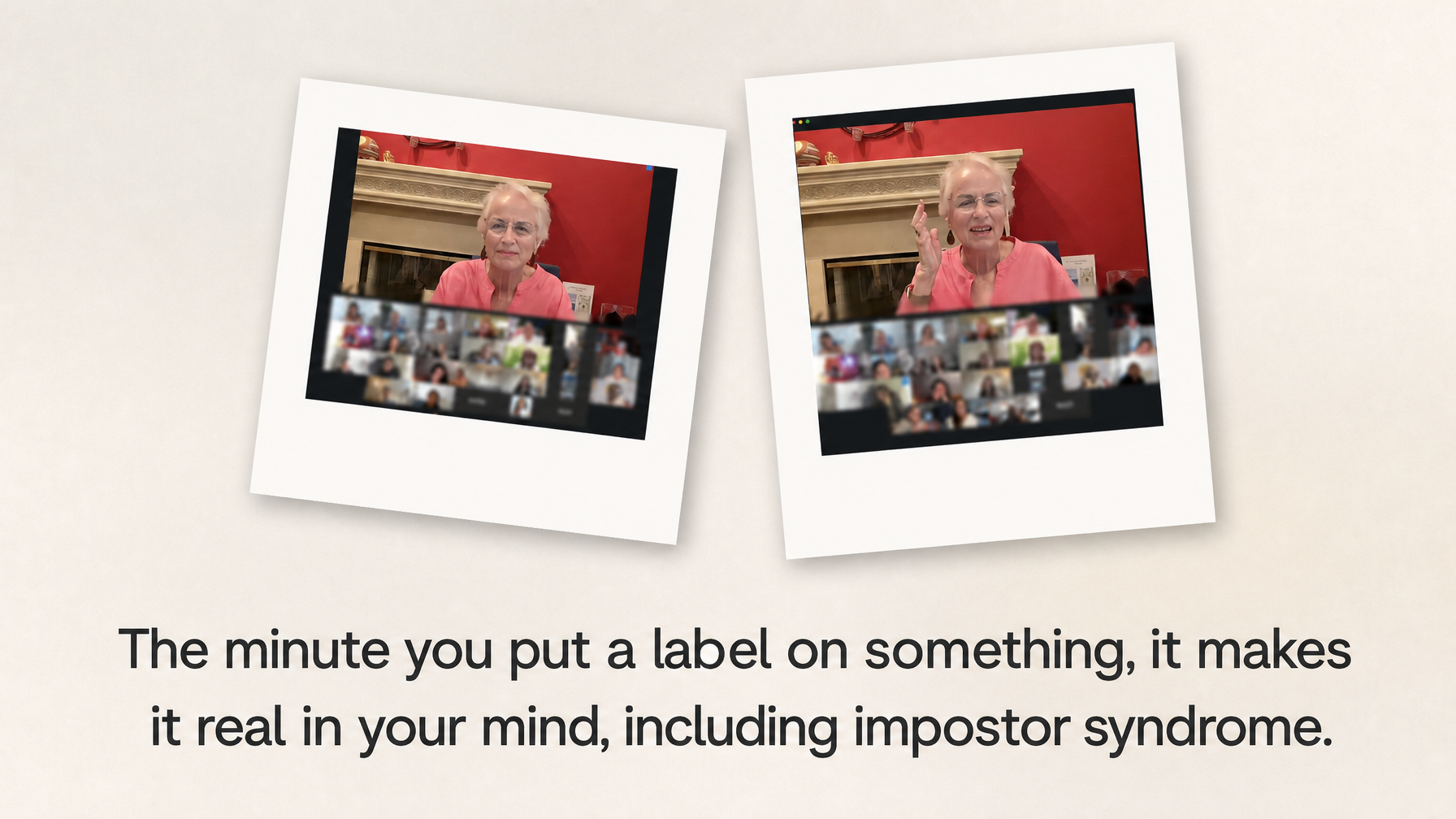
This week I sat in on a webinar by my mentor Dr. Maria Nemeth. She is 82 years old, a psychologist, a master certified coach, founder of Academy for Coaching Excellence and she has been doing this work for fifty years. I’m glad I joined the webinar and took home a bundle of compassionate and loving energy from her.
I want to share what she said, mostly in her own words, because I think some of it will land for you the way it landed for me.
Why your brain gives you negative messages
Dr. Maria opened with something simple and a little humbling.
“Our brain has not changed significantly in one hundred thousand years.”
One hundred thousand years ago, we lived in caves. We didn’t have fur. We couldn’t run very fast. What we did have was a brain that could scan for the possibility of danger, whether it was actually true or not. That brain was there to keep us alive.
She described it like this: imagine you and a group of people are in a cave together, and you’re hungry, and you start planning to walk outside to find food. What is the first thing your brain does?
It looks for predators.
“There are two kinds of mistakes we can make. One of them is planning for saber-toothed cats and there are none. The second mistake is not planning for one, and just walking out into the open, and there is one. Mother Nature would rather have us do the first mistake a million zillion times. Because if we do the second mistake once, we’re dead.”
So the brain learned: when something is new or uncertain, sound the alarm.
The problem is, the brain doesn’t know we’re not living in a cave anymore. It still doesn’t know. So every time you are about to step out into something unfamiliar, a new job, writing something and putting it out there, going somewhere you’ve never been, the brain does what it was designed to do.
“It’s going to say: don’t do it. Not you.”
What imposter syndrome actually is
Dr. Maria said something that reframed this whole concept for me.
“The words ‘imposter syndrome’ were created by those of us in the mental health field as a way of putting a label on things. But the minute you put a label on something, it makes it real in your mind.”
She said what we call imposter syndrome is actually something much more ordinary.
“All imposter syndrome is, is the recognition of a difference between the skill set you have now and the skill set you’re going to need.”
She told a story about a woman named Naomi who had just been appointed to a board. Naomi told Dr. Maria she must have imposter syndrome because she was walking into her first meeting feeling like she didn’t know enough about anything to appear wise and professional.
Dr. Maria told her: good.
“If you joined a board and you thought you had it all together, that’s the first sign that you’re stepping into something you don’t probably know anything about. Because things change. You want to have a little bit of this anxiety. It doesn’t mean you’re an imposter. It means you’re normal.”
Even Michelle Obama said it. She told a crowd that she has always had this gap between what she knows and what she needs to know. “I guess today you call it imposter syndrome,” she said. “But I’ve had this all my life.”
I raised my hand during the Q&A. I said something like: this “not enough” feeling is really familiar to me, and I think I see it especially in people like me who grew up with Asian culture. Regardless of how high our grades were. Even when we came to the US to study further. This “not enough” keeps following. It behaves a little differently from imposter syndrome, but underneath I think they’re connected. It’s the humanity of thinking we are not enough for some mystery standard.
Dr. Maria agrees and shows us a tool on what to do with it.
The three-step practice
Then she gave us something practical. She said she has used this with CEOs, with leaders, with people all over the world. Some of them told her it sounded silly. She said, try it anyway.
Step one: practice compassion for your brain.
“You are not your brain. You have a brain. See that your brain is just trying to do its job. Not to be at war with your brain. Not to say, why is it saying these things to me? It thinks it’s one hundred thousand years ago. It just still does.”
So you say: I see you, brain. I see that you’re working very hard. I see that you’re wanting to keep me out of danger.
Step two: gently soothe it.
“It’s okay, honey.”
She literally said it out loud in the webinar. Softly. She said it in a way that wasn’t dramatic or forced, just a quiet acknowledgment.
“Your brain will listen to you if you speak kindly to it.”
Someone named Cong asked a follow-up question: what if I try the compassion part but I can’t shift? I keep being gentle with myself but I can’t move forward. Dr. Maria responded right away.
“This is not a project. Most of the people here have learned to become very performance-driven. That’s not the way to approach this. The practice is being gentle. Be sweet. Be compassionate. Be loving. Be appreciative.”
She said to think of the amygdala, the almond-shaped part of the brain where fear lives, like a child. You don’t tell a frightened child to stop being frightened. You sit with them.
Step three: the 3×5 card.
This is the phrase she calls the bridge, and she attributed it to Dag Hammarskjöld, the second Secretary-General of the United Nations. His full line was:
“For everything that has been, I say thank you. And to all that is yet to be, I say yes.”
Dr. Maria distilled this down to three words.
“I am willing.”
And then she added one more.
“Nevertheless.”
“Nevertheless, I am willing.”
She explained what that word means. Nevertheless means: without taking anything away from what came before. You’re not denying the fear, you’re not pretending it isn’t there. You’re saying thank you to it, and then you’re moving anyway.
“Being willing elevates you above the smog or the fog of the negativity. You can look down on your doubts and fears, your I-don’t-want-to’s, your imposter syndrome. And you can say: nevertheless, I’m willing.”
Write it on a card. Put it somewhere visible. And when the brain starts up again, repeat the whole sequence. Compassion. It’s okay. Nevertheless, I’m willing.
“You’re training it. You’re training it. You’re training it.”
What this opened up for me
I have worked with clients who get stuck right at the edge of something new. A career transition. Putting their voice out into the world. Trying something they’ve always wanted to try but kept deferring.
What strikes me about Dr. Maria’s framework is that it doesn’t ask you to eliminate the fear or outthink the negative voice. It asks you to treat it like a part of you that is frightened and doing its best. Because that is exactly what it is.
What really strikes me is when we put a label to something, it makes it exist. So all these “not enough” voices are just the brain trying to protect us; it’s just the brain getting scared.
In the end, I get to see everything as is: a scared brain and our desire to make a difference for others or for the world.